TRIDENT’s campaign to gather environmental data
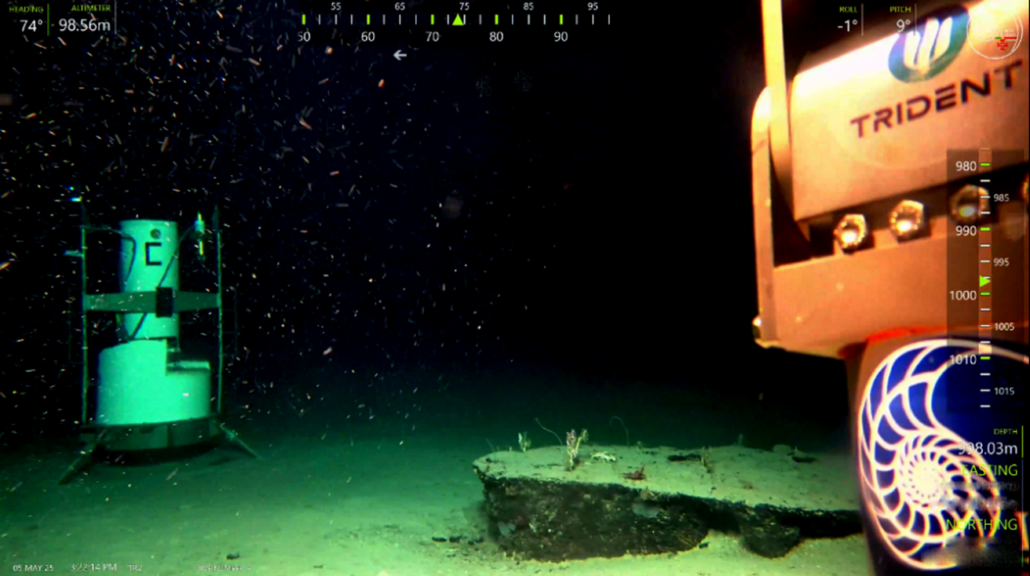
On 15th May 2025, after 24 days at sea, the RV Sarmiento de Gamboa docked in Vigo, Spain after completing the second TRIDENT environmental baseline survey. The main goals of the campaign were to finalize the baseline, filling remaining parameter gaps, and enriching our knowledge of temporal and spatial environmental variability. This campaign builds on last year’s campaign onboard the RV Mario Ruivo where five Little MonSta monitoring platforms were deployed to provide a 10-month time-series of changing seabed environmental conditions in terms of water properties, current flow speed profiles with periodic sediment and microfossil sampling.
Professor Andy Wheeler (UCC), who looks after the Little MonStas said “It was a relief, as always, to get all out instruments back, the data looks exciting and will give an insight into areas not sampled before, as well as giving us the full picture of the dynamics of summit environments”. In addition, to recovering the Little MonStas with the ROV Luso (EMEPEC), Luso also explored seamount areas, collecting samples for further analysis.
A key question to be answered by the environmental baseline survey is “what is the extent of natural environmental variability and where are vulnerable habitats”. The rich dataset collected by TRIDENT, supplemented by previous survey data, reveals a reliable picture to help afford protection to seamount summit environments for future activities, should any occur. The model includes physio-chemical parameters in the upper and near seabed water column (temperature, salinity, redox potential, turbidity, dissolved oxygen, chlorophyll, Eh and pH), a full water column hydrographic model, a near field light radiation model, a far field sound propagation model, high resolution bathymetry, sediment properties, sub-seabed stratigraphies, microorganism assessments and a biotope model with sensitive indices. Dr Javier González (IGME-CSIC), chief scientist, commented that “seamounts never fail to amaze, typically at 1000 m below the sea surface, they are places where geological, hydrological and (micro)biological processes combine to create rich resources”.
“Seamounts never fail to amaze, typically at 1000 m below the sea surface, they are places where geological, hydrological and (micro)biological processes combine to create rich resources.”
Dr Javier González (IGME-CSIC).
The campaign falls into TRIDENT’s endeavour to develop and demonstrate protocols for environmental baseline construction for deep-sea impact assessments. This second campaign was coordinated by IGME-CSIC, with the participation of EMEPEC (ROV Luso), UCC (Little MonStas), CINTAL (sound monitoring), NOC, IPMA, ICM-CSIC, UTM-CSIC (technical support) and INESC TEC (ROV support).