TRIDENT Successfully Held Second Webinar!

The second TRIDENT webinar focused on deep sea ecosystem health and offered participants an opportunity to share their current knowledge and results.

This event took place on 18 November, 2025 from 11.00 h to 13.00 h CET and brought together a total of 21 participants.

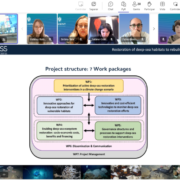
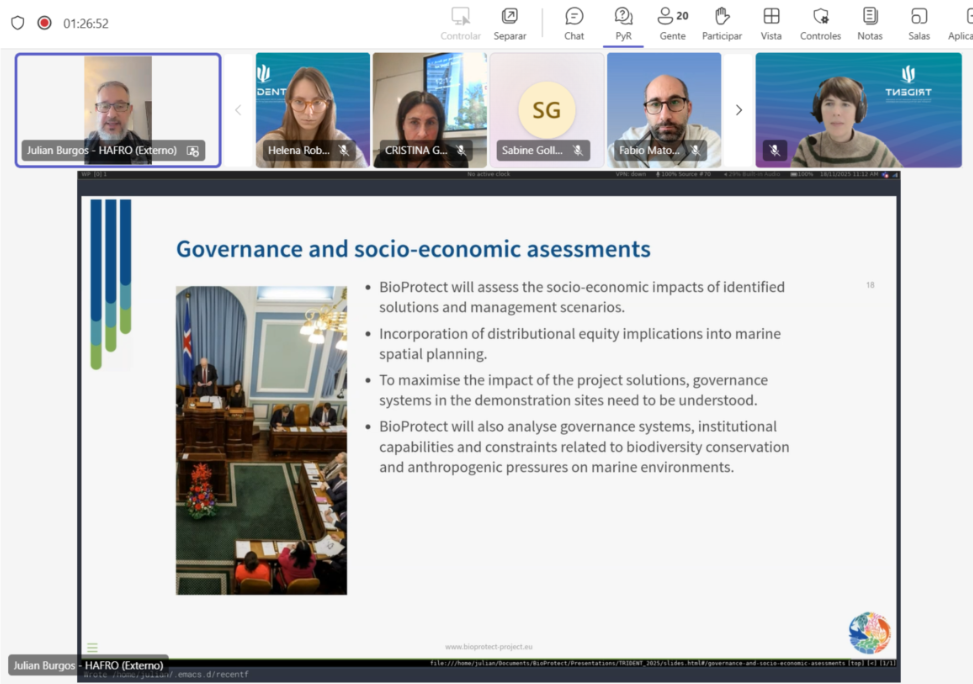
During the two hour session four EU funded projects presented their research activities in the field of deep sea protection: MiningImpact, GES4SEAS, REDRESS and BioProtect. The speakers introduced their research locations and explained the ocean regions where their work is carried out. They also described the technologies used in their studies, including specialised equipment designed for operations at great depths. The last speaker was Andrew Wheeler from TRIDENT, who spoke in his presentation about Defining Environmental Baselines for Deep-Sea Disturbance Monitoring. This topic represents Work Package 2 of the TRIDENT project. The webinar concluded with a presentation of the TRIDENT project followed by an open discussion where participants asked further questions and exchanged experiences.

Together, the participating projects advance scientific understanding of deep sea ecosystems and the tools required to protect them. MiningImpact evaluates the ecological effects of deep sea mining and defines indicators and thresholds for significant harm. GES4SEAS builds on these insights to support effective marine management and to reduce human pressures in key deep sea regions. REDRESS identifies degraded habitats and develops methodological guidance for their restoration. BioProtect strengthens this framework through modern biodiversity monitoring methods, including eDNA, aimed at safeguarding and regenerating deep sea environments.

We would like to thank all participants and especially the representatives of the individual projects who delivered their presentations and generously shared their expertise during the discussion. Our appreciation goes to Sabine Gollner, Fábio L. Matos, Cristina Gambi and Julian Burgos.

We look fordward to seeing you on our next events!

Sustainable Deep Sea Webinar

A clustering webinar of EU-funded projects on environmental assessment of deep-sea ecosystems.

Following the success of the first TRIDENT clustering webinar in April 2024, we are excited to host the second one, taking place in November 18th, 2025 from 11:00 to 13:00 CET (10:00h – 12:00h WET). This session aims to foster collaborative dialogue among projects at the forefront of deep-sea environmental science, providing a platform for knowledge exchange, discussion, and the advancement of sustainable practices in deep-sea research and management.

The webinar will feature contributions from several prominent Horizon Europe and JPI Oceans projects. MiningImpact (GEOMAR / JPI Oceans) investigates the ecological consequences of deep-sea mining, developing indicators for ecosystem health and thresholds for serious harm. GES4SEAS (Fundación AZTI) works to inform marine governance and reduce human pressures on biodiversity, focusing on deep-sea ecosystems such as the Deep Atlantic–Mediterranean transition. REDRESS (Università Politecnica delle Marche) identifies degraded deep-sea habitats and guides restoration efforts through environmental baselines and thresholds. Finally, BioProtect (Matis Ohf) aims to protect and restore deep-sea ecosystems through biodiversity monitoring, citizen science, and innovative tools such as eDNA sampling.

During the webinar, participants will explore how different projects define and assess deep-sea ecosystem health, discuss the role of environmental baselines and thresholds in impact assessment, conservation, and restoration planning, and share lessons learned from monitoring, modelling, and fieldwork. The session will also highlight opportunities for cross-project collaboration and data sharing and consider how these efforts contribute to broader EU policy goals, including the Nature Restoration Law, promoting sustainable ocean stewardship.

Find the registration link in the agenda, we look fordward to seeing you there!

Kobe (Japan) Workshop Charts Future of Seabed Monitoring with AI and Robotics

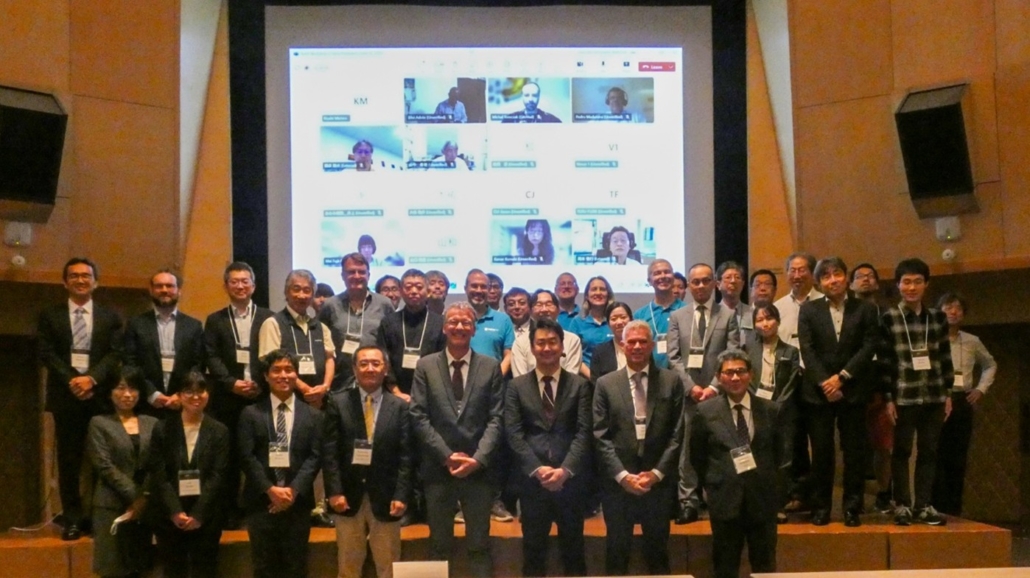
The Second International expert scooping workshop “Charting future horizons: Harnessing advanced technologies for the protection and sustainable use of the international seabed area – Focus on monitoring” was held in June 2025, with the participation of the project Coordinators. During this event that took place in Kobe, Japan, international experts focused on the develop of technologies for environmental monitoring of the seabed, exploring how tools like robotics, AI, and autonomous systems can support responsible ocean data collection and resource management.

Organised by ISA, in collaboration with the Kobe Ocean-Bottom Exploration Center (KOBEC) at Kobe University, the event addressed technology readiness, real-time data strategies, and the role of innovation in supporting the International Seabed Authority’s environmental goals.

The project’s coordinators, INESCTEC, had the oportunity to present the latest achievements of TRIDENT and its focus on the development of new technological tools for deep sea impact assessment.

TRIDENT’s campaign to gather environmental data

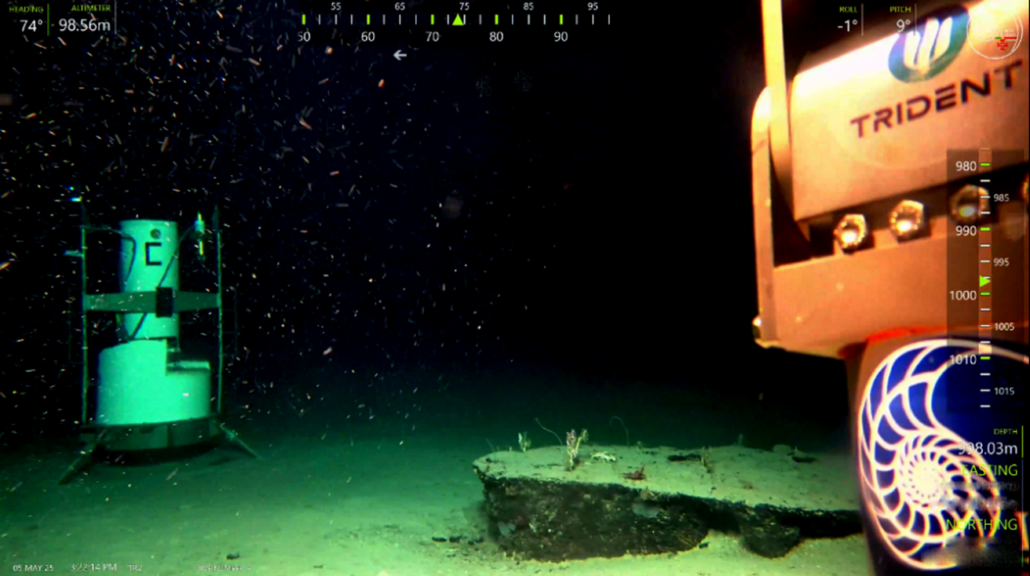
On 15th May 2025, after 24 days at sea, the RV Sarmiento de Gamboa docked in Vigo, Spain after completing the second TRIDENT environmental baseline survey. The main goals of the campaign were to finalize the baseline, filling remaining parameter gaps, and enriching our knowledge of temporal and spatial environmental variability. This campaign builds on last year’s campaign onboard the RV Mario Ruivo where five Little MonSta monitoring platforms were deployed to provide a 10-month time-series of changing seabed environmental conditions in terms of water properties, current flow speed profiles with periodic sediment and microfossil sampling.

Professor Andy Wheeler (UCC), who looks after the Little MonStas said “It was a relief, as always, to get all out instruments back, the data looks exciting and will give an insight into areas not sampled before, as well as giving us the full picture of the dynamics of summit environments”. In addition, to recovering the Little MonStas with the ROV Luso (EMEPEC), Luso also explored seamount areas, collecting samples for further analysis.

A key question to be answered by the environmental baseline survey is “what is the extent of natural environmental variability and where are vulnerable habitats”. The rich dataset collected by TRIDENT, supplemented by previous survey data, reveals a reliable picture to help afford protection to seamount summit environments for future activities, should any occur. The model includes physio-chemical parameters in the upper and near seabed water column (temperature, salinity, redox potential, turbidity, dissolved oxygen, chlorophyll, Eh and pH), a full water column hydrographic model, a near field light radiation model, a far field sound propagation model, high resolution bathymetry, sediment properties, sub-seabed stratigraphies, microorganism assessments and a biotope model with sensitive indices. Dr Javier González (IGME-CSIC), chief scientist, commented that “seamounts never fail to amaze, typically at 1000 m below the sea surface, they are places where geological, hydrological and (micro)biological processes combine to create rich resources”.

“Seamounts never fail to amaze, typically at 1000 m below the sea surface, they are places where geological, hydrological and (micro)biological processes combine to create rich resources.”

Dr Javier González (IGME-CSIC).

The campaign falls into TRIDENT’s endeavour to develop and demonstrate protocols for environmental baseline construction for deep-sea impact assessments. This second campaign was coordinated by IGME-CSIC, with the participation of EMEPEC (ROV Luso), UCC (Little MonStas), CINTAL (sound monitoring), NOC, IPMA, ICM-CSIC, UTM-CSIC (technical support) and INESC TEC (ROV support).

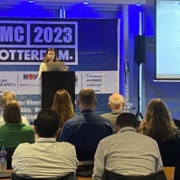
INESC TEC presented “Technology based impact assesment for sustainable, transparent deep-sea mining exploration and explotation” in Underwater Minerals Conference 2023

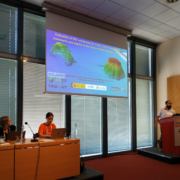
Egidio Marino, from IGME, presents the communication “Evaluation of REY enrichment in Fe-Mn crusts from different seamounts and depths in the Canary Island Seamount Province” at Goldschmidt 2023

Workshop “Underwater mining impact assessment”